Design and production of
prefabricated tanks in modular metal
Modular metal tanks: fast installation, factory quality and cost efficiency
A prefabricated tank (prefabricated / modular tank) has its main components produced in the factory, then shipped to site as panels or modules and assembled there.
1. Introduction — prefabricated tank fabrication
Modular metal tanks: fast installation, factory quality and cost efficiency
The rapid growth of industry, urban development and the ever-increasing need for water, fuel and chemical storage infrastructure have pushed the tank industry towards solutions in which speed of execution, guaranteed quality and flexibility in transport play a decisive role. Among these, the "prefabricated tank" (prefabricated / modular tank) has emerged as one of the most successful engineering answers to these needs.
In the prefabrication approach, the main components of the tank are produced and prepared in the controlled environment of a factory instead of being built entirely at the project site, and are then transported to site as standard parts or modules and assembled there. Moving the fabrication stage from the site to the factory brings a major change in the quality, safety and economics of the project.
Behineh Ab Engineering, focusing on the production of metal tanks (carbon steel, galvanized and stainless steel) and using factory production lines, supplies prefabricated tanks that offer high structural strength together with modular transport and fast installation.
2. What is a prefabricated tank?
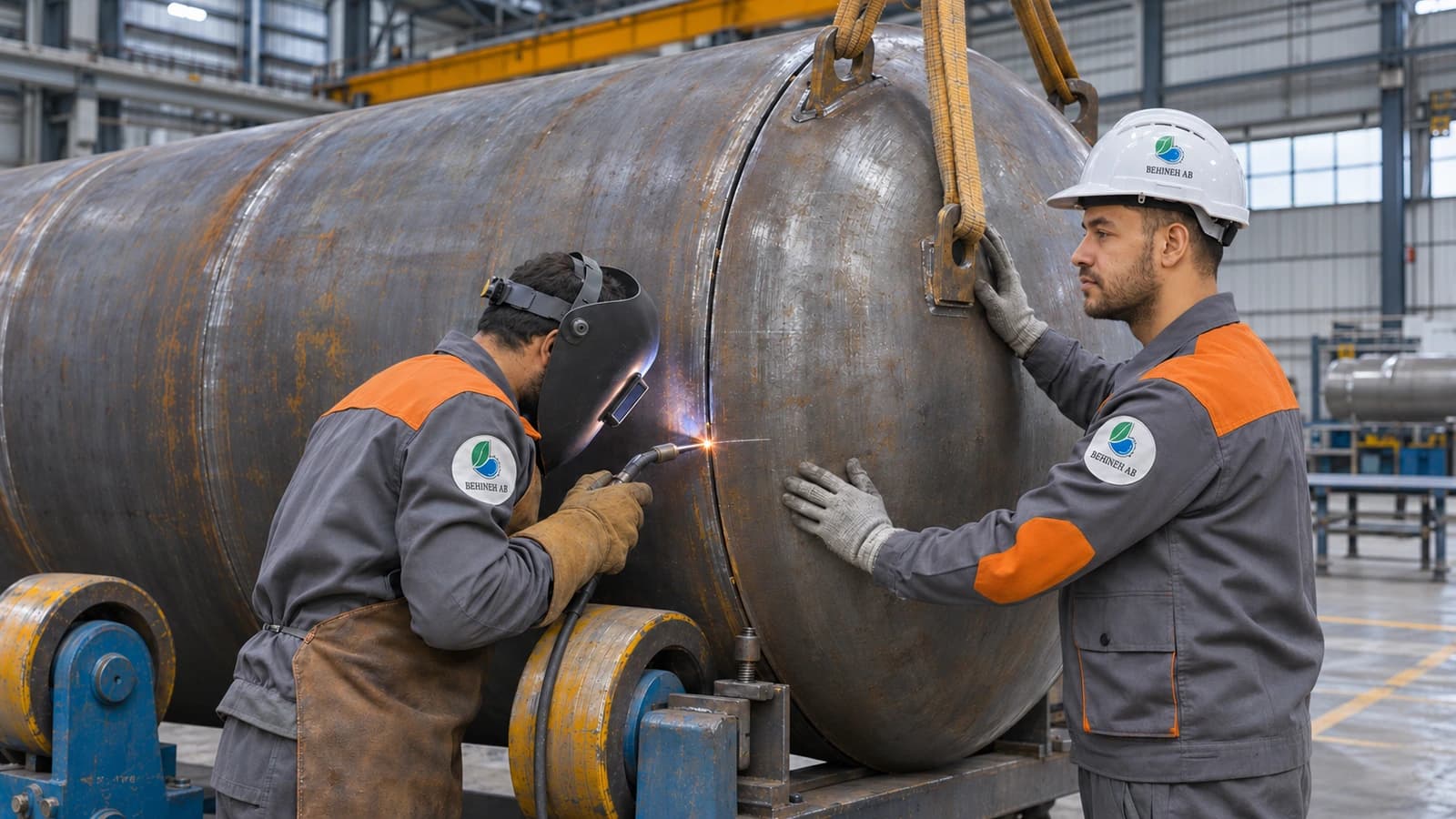
A prefabricated tank is a fluid storage structure whose design, cutting, forming, initial welding and preparation of connections are carried out in the factory, and which is finally sent to the place of use as panels, plates or prefabricated modules. Unlike field-erected tanks, where all welding and assembly is done on site, in a prefabricated tank most of the fabrication work is complete before it reaches the site.
This definition covers a wide range of products, from panel tanks built by placing standard plates side by side and bolting them together, to fully prefabricated portable steel tanks that only need to be set in place and connected to the piping.
In field erection, dimensional accuracy and weld quality depend on site conditions, the skill of the crew and uncontrollable factors such as the weather. In prefabrication, these variables are controlled in the factory, and the result is a product with repeatable, guaranteed quality.
Key indicators of prefabrication
The three main factors that determine the value of a prefabricated metal tank:
Because the parts are standard, a small assembly crew with no heavy welding equipment can assemble the tank in a few days; an equivalent field-erected tank may take weeks.
3. Advantages of prefabrication
The main advantage of prefabricated tanks can be summarised in three key areas: shorter installation time, factory quality control and modular transport.
Because most of the fabrication is done before arriving on site, the time the project site is occupied is kept to a minimum. Site work is mainly limited to the foundation, placing the parts and assembly. Project execution time is cut by around 40 to 70 percent compared with field erection. Work can run in parallel: while the foundation is being built on site, the tank is being fabricated in the factory. Operation starts sooner and the investment pays back faster.
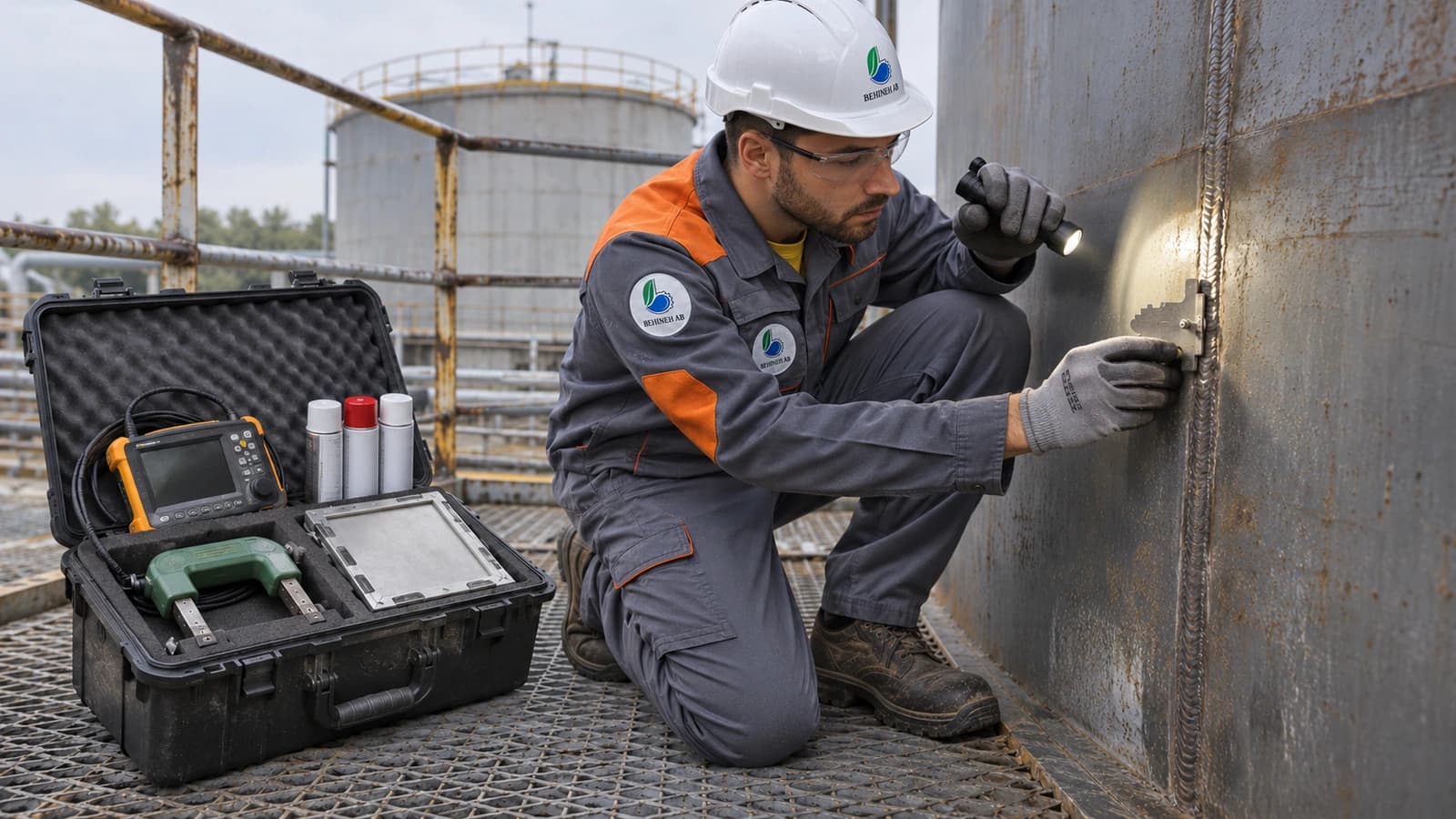
Welding with automatic and semi-automatic machines of uniform quality. Non-destructive testing (NDT) such as radiography, ultrasonic testing and leak testing under controlled conditions. Protective coatings (hot-dip galvanizing, epoxy, industrial paint) applied in a suitable environment without the effect of site humidity and dust. Precise control of dimensions, plate thickness and joint tolerances according to the engineering drawings.
Transport with an ordinary fleet without escort traffic or oversize-load permits. The tank can be delivered to remote and hard-to-reach areas and to projects beyond the reach of heavy cranes. Lower transport cost and compact packing of the panel parts.
Greater safety by reducing high-risk operations on site (welding at height, work in confined spaces). Relocation and expansion: many prefabricated tanks can be dismantled, reassembled and increased in capacity. Less waste and environmental impact at the project site.
4. Types of prefabricated metal tanks
Although FRP panel tanks are also on the market, Behineh Ab Engineering focuses on metal tanks, which offer greater structural strength, longer life and higher mechanical resistance.
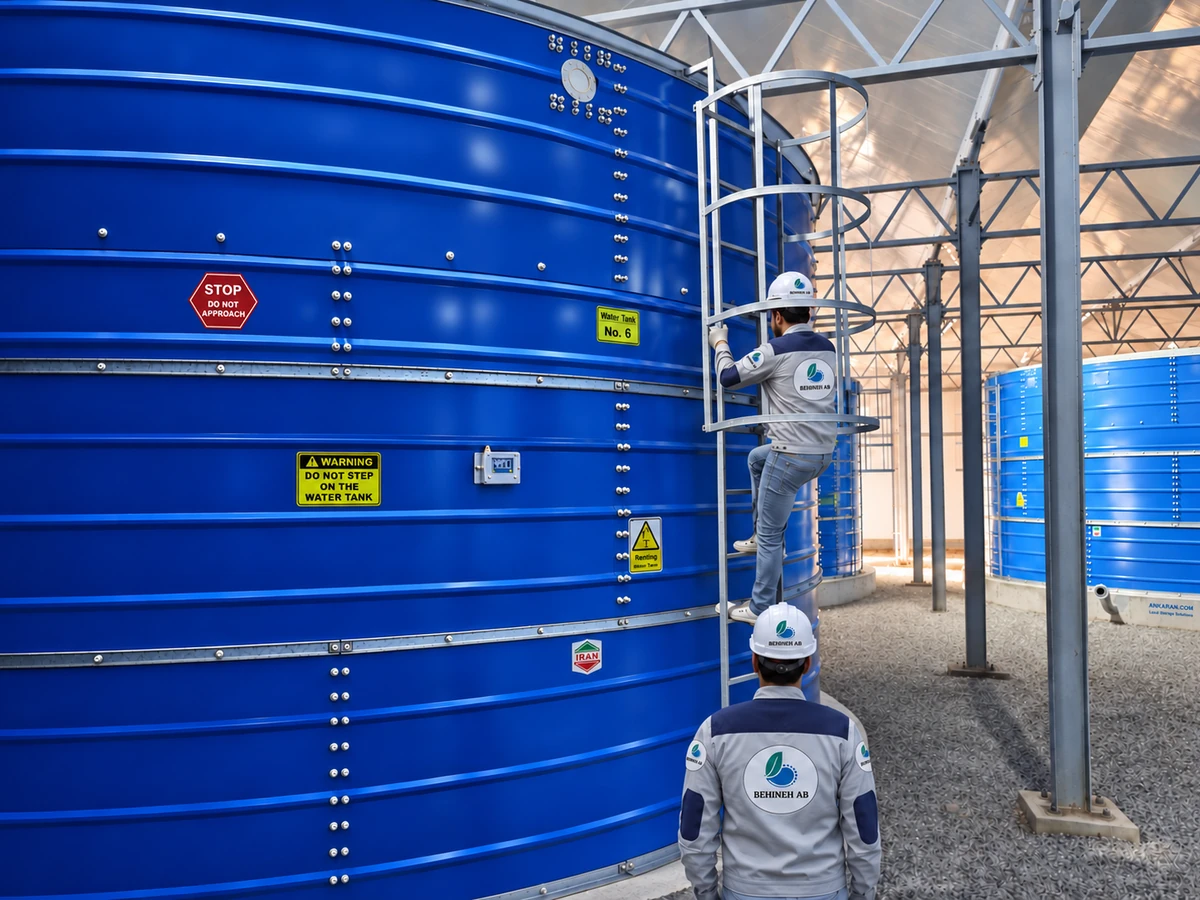
Hot-dip galvanized or coated steel panels are pressed, punched and prepared in the factory and joined on site with bolts and sealing washers. High corrosion resistance thanks to the zinc coating. Capacity can be increased by adding a row of panels. Suitable for drinking water, fire fighting, irrigation and wastewater. No welding needed on site.
Steel panels with coatings such as glass fused to steel (glass-fused-to-steel) or industrial epoxy. Suitable for more corrosive fluids and long-life projects.
Fully prefabricated stainless steel or carbon steel tanks in one piece or several sections. Hygienic and suitable for the food, pharmaceutical and drinking water industries (304 and 316). Quick relocation between sites; ideal for temporary and emergency projects.
| Feature | Bolted galvanized | Glass-fused panel | Portable steel |
|---|---|---|---|
| Main material | Galvanized steel | Steel + glass coating | Stainless/carbon steel |
| Corrosion resistance | Good | Excellent | Excellent |
| Installation speed | Very high | High | Immediate |
| Can be relocated | Yes | Yes | Very easily |
| Typical use | Water and fire fighting | Wastewater and industrial | Food/emergency |
5. The assembly process on site
Assembly is carried out step by step, based on the factory's standard instructions:
A level, strong concrete base built for the design load; this can be done at the same time as the parts are made in the factory.
Laying the floor plates or base ring on the foundation and levelling them precisely.
Installing the panels row by row from bottom to top and tightening the bolts to a controlled torque.
Placing gaskets and special sealants between the panels to ensure there are no leaks.
Fitting the roof, inspection hatch, inlet/outlet nozzles, overflow and instrumentation.
If needed, repairing the coating at the joints.
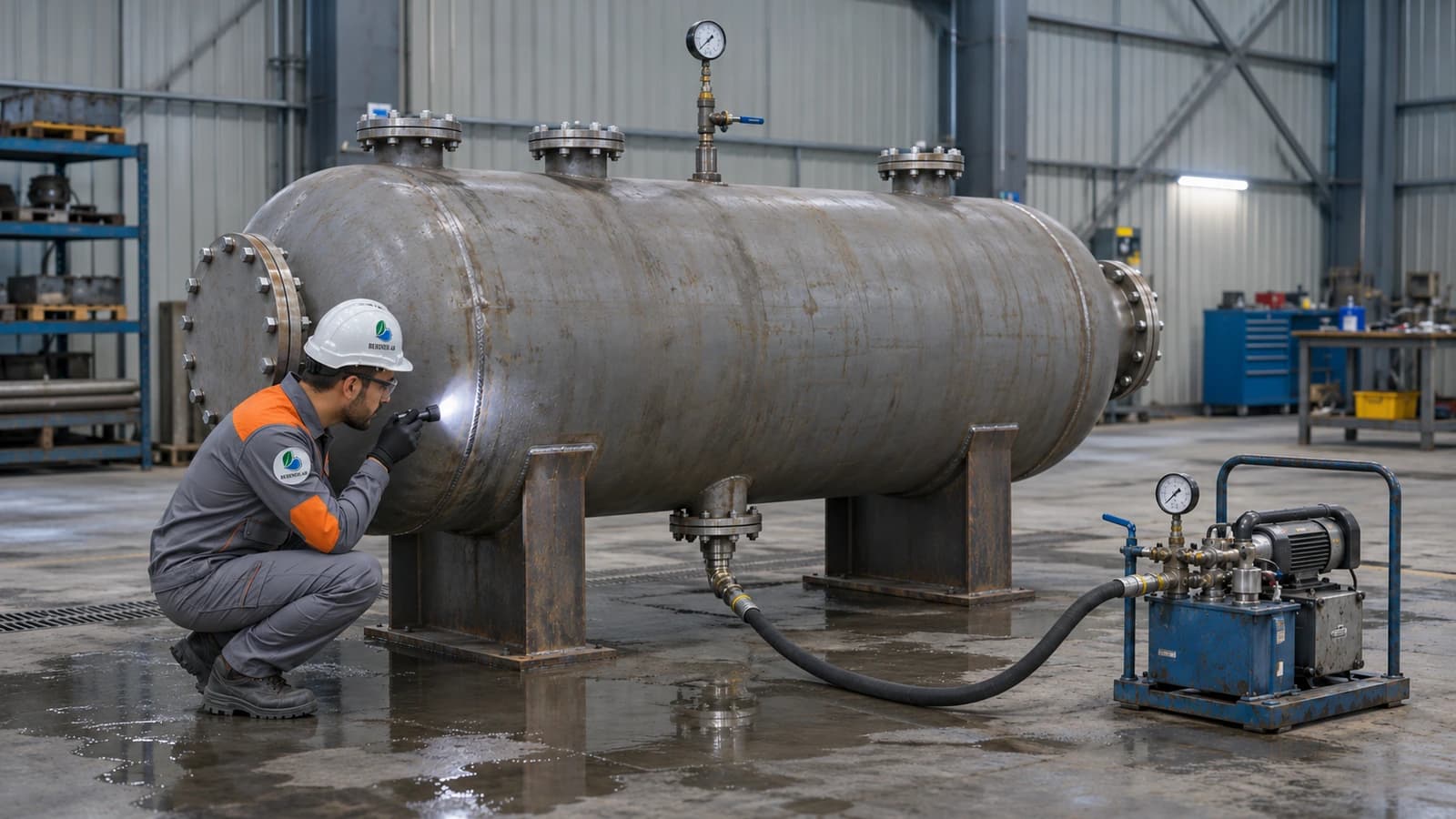
Filling the tank, carrying out the leak test (hydrostatic test) and handing it over to the operator.
6. Use in emergency projects and remote areas
Modular transport and fast installation make prefabricated metal tanks an unrivalled option in special conditions.
Supplying drinking water to earthquake- and flood-hit areas in the shortest possible time. Temporary fire water tanks for fighting fires in critical situations. Fast storage of fuel and water in relief operations and temporary camps.
Mining, oil and gas projects in desert and mountain areas where access for heavy cranes is difficult. Villages and areas without infrastructure, where field erection and a skilled welding crew are not available. Islands and coastal areas, where shipping modular parts is cheaper than moving fabrication equipment.
7. Economic comparison with field erection
The economic assessment should go beyond the initial price and be based on the total cost of ownership and of the project.
| Indicator | Prefabricated tank | Field erection |
|---|---|---|
| Project execution time | Short (days/weeks) | Long (weeks/months) |
| Site labour cost | Low | High |
| Quality and repeatability | High and guaranteed | Depends on the site |
| Transport cost | Medium (modular) | Low (raw materials) |
| Can be relocated | Yes | No |
| Suitability for remote areas | Very suitable | Difficult/costly |
| Total cost of ownership (TCO) | Optimal | Higher in most cases |
Although the cost of transporting the modules may be slightly higher, the shorter execution time, smaller site workforce and guaranteed quality mean that the total project cost of prefabricated tanks is lower in most situations and the investment pays back faster.
8. Conclusion
Prefabricated metal tanks offer a combination of speed, quality and flexibility that meets the needs of today's industry. Factory quality control, a dramatic cut in installation time and modular transport make these tanks a better option than field erection, especially in emergency projects and remote areas.
Relying on its ability to produce galvanized, coated and stainless steel metal tanks, Behineh Ab Engineering is ready to design, fabricate and assemble all kinds of prefabricated tanks to suit clients' needs, and can provide integrated services from consultation and design through factory production to final assembly on site.
Behineh Ab Engineering — our speciality is industrial metal tank fabrication
Technical specifications
Applications and industries
Photo gallery
Prefabricated tank gallery
Frequently asked questions
Request a quote
Prefabricated tank fabrication
Enter the pressure, temperature and fluid; our engineers send a technical proposal and price within 24 working hours.
- Written technical reply with a proposed concept drawing
- Site visit in Tehran and surroundings
- 24-month warranty on fabrication and welding