The steps of building a steel tank, from the data sheet to testing and dispatch. A 20,000-litre tank takes about three weeks; here is what that time is spent on.
How many steps does tank fabrication have?
On paper, building a tank looks simple: roll a few plates, weld on two heads and you are done. In practice every tank goes through seven steps, and if one of them is rushed, the defect usually shows up in testing or, worse, in operation.
- Receiving the data sheet and order specification
- Design, thickness calculation and fabrication drawings
- Sourcing plate and materials
- Cutting, shell rolling and head forming
- Assembly, welding and nozzle installation
- Testing and inspection
- Painting, packing and dispatch
For a 20,000-litre steel tank, this route takes about three weeks in our factory. Larger tanks go through the same steps, except that part of the work moves to the project site. We explain on-site construction further down.
1. The data sheet: before any calculation
Our first question to the client is not "how many litres?". First we ask what is going to go inside the tank. Drinking water, diesel, sulphuric acid and compressed air each need a different plate material, design standard and type of test.
| Information needed | Why it matters |
|---|---|
| Type of fluid and its density | Sets the plate material and the hydrostatic load on the shell |
| Working volume | Determines the dimensions, the number of shell courses and the tank's weight |
| Working pressure and temperature | The boundary between an atmospheric tank (API 650) and a pressure vessel (ASME) |
| Vertical or horizontal, ground-mounted or elevated | Defines the type of legs, supports and foundation |
| Installation site | Sets the wind and seismic loads and whether road transport is possible |
| Nozzles and accessories | Manhole, ladder, level gauge and anything else that must be welded to the shell |
You don't need a complete data sheet in hand. Tell us the fluid and the volume, and the technical office will complete the rest with you. For a first estimate of dimensions and weight you can also use the online calculators on the site.
2. Design and thickness calculation
We design atmospheric storage tanks to API 650 and pressure vessels to ASME Section VIII. In both, the shell thickness comes from the pressure (or the height of the liquid column), the diameter, the plate's allowable stress, the joint efficiency and the corrosion allowance.
The output of this step is not just a thickness figure. The fabrication drawings, nozzle layout and bill of materials are prepared too. It is this bill of materials that sets the tank's weight, and the fabrication price is largely calculated from it.
If the weld seams are fully radiographed, the joint efficiency rises and the required thickness falls. Thinner plate means less weight and, in large tanks, often a lower total cost, even after the cost of testing is taken into account.
3. Sourcing plate and materials
We buy plate, pipe and flanges by the kilo. That is why a tank's price depends above all on its fabricated weight, not its volume. Two tanks of the same volume, one for water and the other for 10 bar of pressure, have completely different weights and prices.
Every plate bundle must come with the mill test certificate (MTC) so that its grade, chemical composition and mechanical properties can be checked against the drawing. For special plate such as 316 stainless or titanium, sourcing the material sometimes takes longer than the whole fabrication.
4. Cutting, rolling and head forming
The plates are cut to the developed-shape drawing and the edges are bevelled for welding. Then the rolling machine turns the flat plate into a cylinder. The accuracy of this step shows in the roundness of the shell: a shell that has not been rolled well will not mate with the head during assembly, and the welder has to force it into place.
The heads are formed on dishing and flanging machines. The type of head, i.e. torispherical, 2:1 elliptical or hemispherical, is chosen from the pressure calculations and also affects the tank's thickness and weight.
5. Assembly and welding
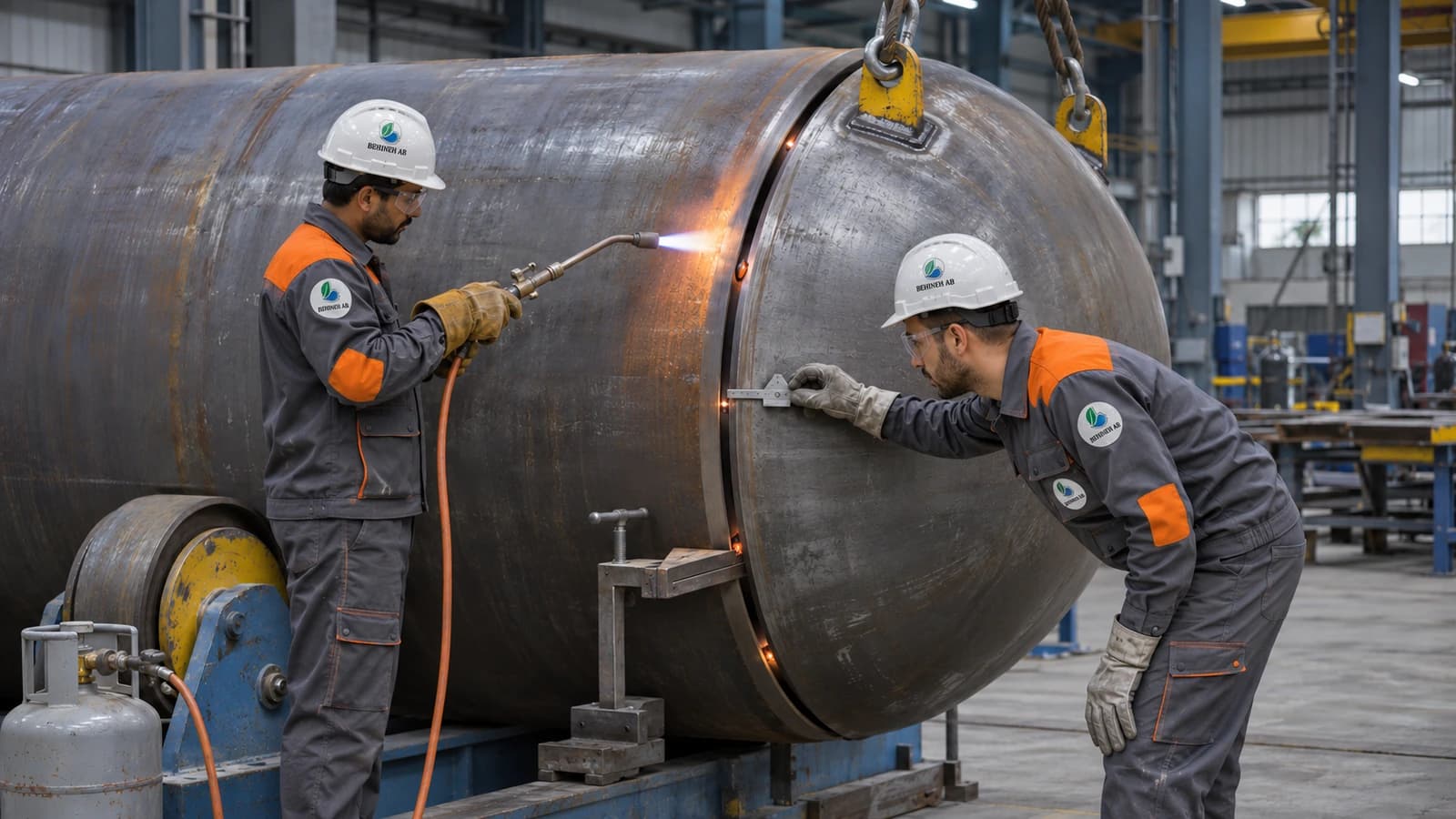
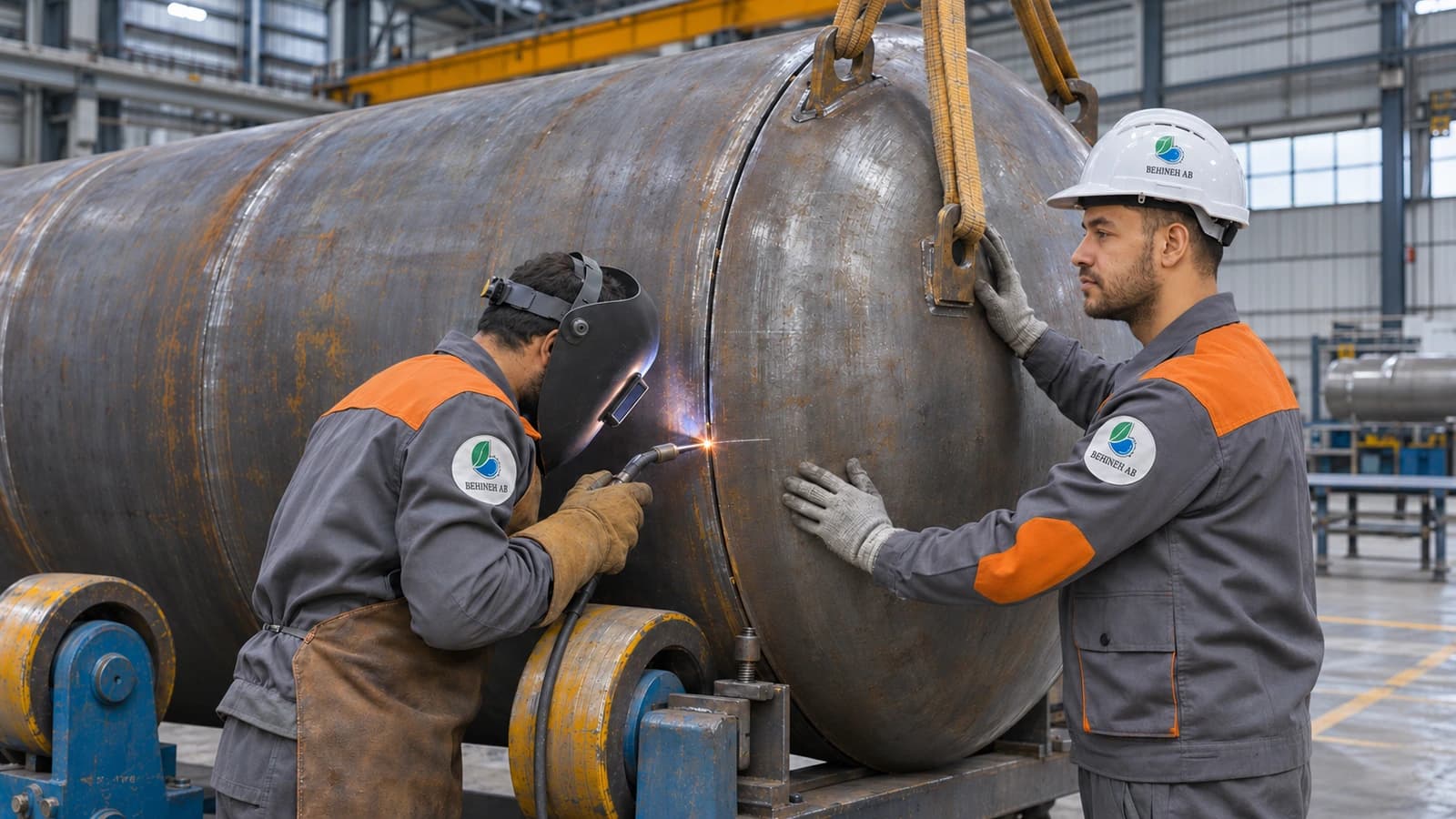
The shell courses are stacked, the heads are fitted, and then it is time for the main welds. Every weld is made to a welding procedure specification (WPS) by a qualified welder. Long longitudinal and circumferential seams are usually made with submerged arc welding, which is both faster and more uniform.
Nozzles, the manhole and the supports are added at this step. The position of every opening must already have been accounted for in the calculations. A hole cut in the shell later may need a reinforcing pad that was not on the drawing.
6. Testing: which ones we do ourselves
We carry out the hydrostatic test in our own factory: the tank is filled with water and the pressure is raised to the value set by the code. The other non-destructive tests, i.e. radiography, ultrasonic, liquid penetrant and magnetic particle, are carried out by a third-party inspection company.
The reason for this division of work is simple. A report signed by an independent company carries more weight with the client and the project inspector than a report the manufacturer has written about its own work. For the bottoms of large tanks a vacuum box test is also done, usually at the installation site.
| Test | What it finds | Who carries it out |
|---|---|---|
| Hydrostatic | Leaks and the strength of the whole tank under pressure | Behineh Ab |
| Radiography (RT) | Defects inside the weld such as porosity and lack of fusion | Third-party inspection company |
| Ultrasonic (UT) | Internal defects and plate thickness | Third-party inspection company |
| Liquid penetrant (PT) | Surface cracks, especially in stainless steel | Third-party inspection company |
| Magnetic particle (MT) | Surface and near-surface cracks in carbon steel | Third-party inspection company |
| Vacuum box | Leaks in the bottom plate welds | Third-party inspection company |
7. Painting, packing and dispatch
After passing the tests, the tank surface is prepared and painted. The paint system depends on the fluid and the environment: epoxy for the inside of water and fuel tanks, polyurethane for the outside of a tank that stands in the sun. A stainless tank is usually not painted, only pickled and passivated.
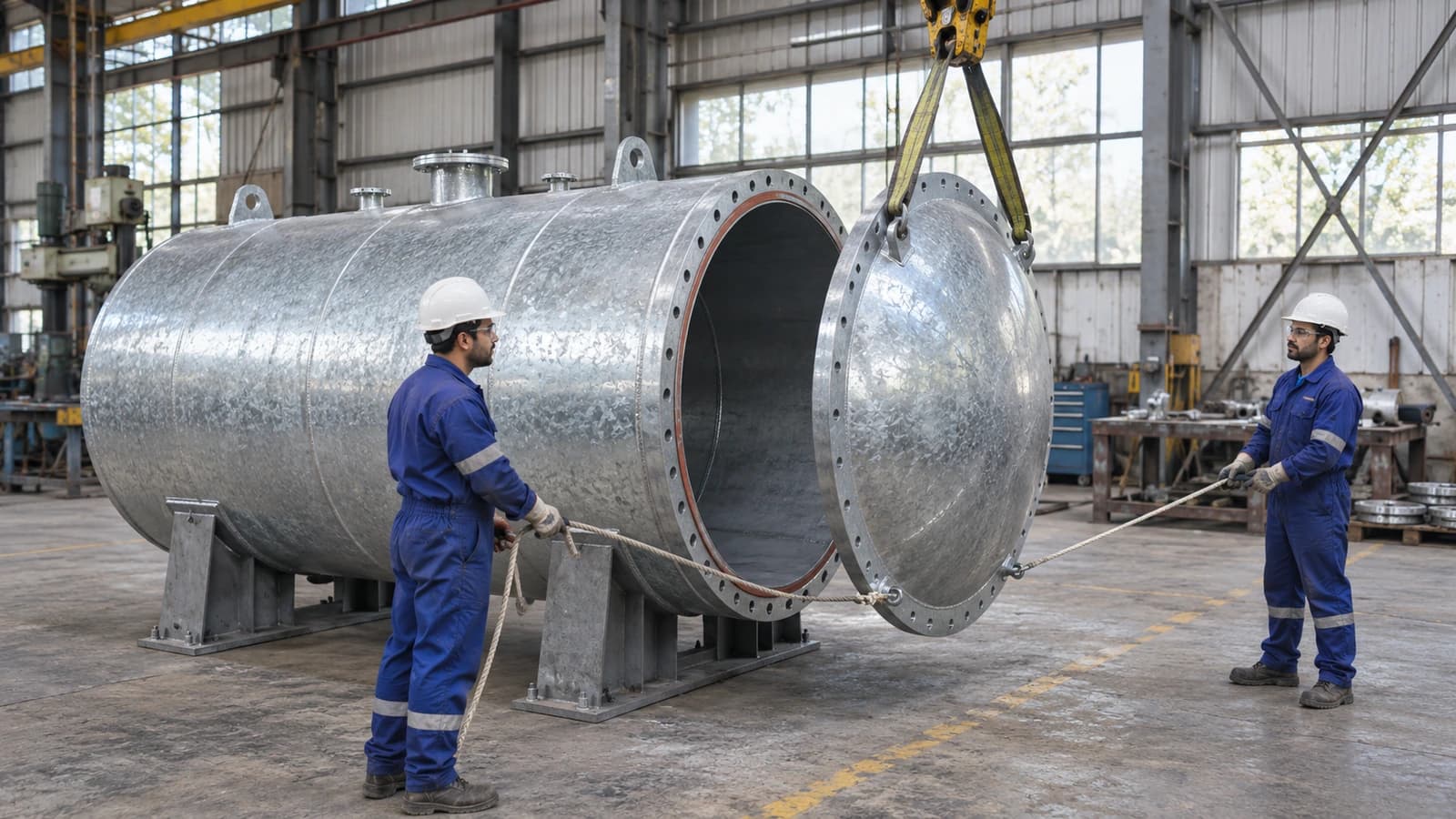
Before dispatch, the nozzles are closed with covers and the tank is loaded on saddles or a skid. The handover documents include the final drawings, the material certificates and the test reports.
Large tanks: construction on site
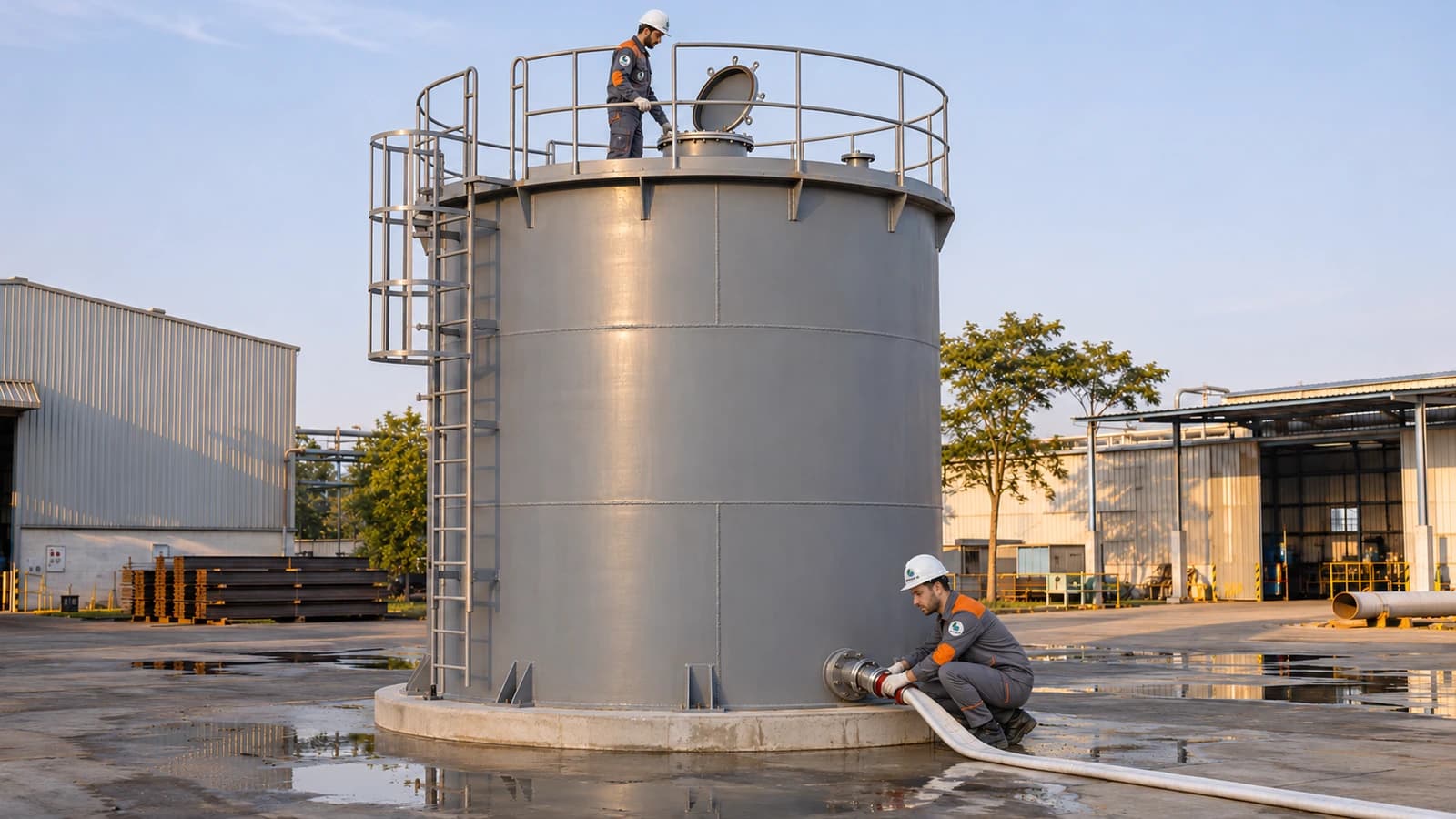
When a tank's diameter exceeds the limit for road transport, as with most oil and water tanks of several thousand cubic metres, we do not build it in one piece. The plates are usually cut, bevelled and rolled in the factory, and assembly and welding are done at the project site.
On-site tank construction has its own steps: taking over the foundation, welding the bottom plates, raising the courses and installing the roof. The hydrostatic test is also done there by filling the tank, and the settlement of the foundation is measured during filling.
What makes fabrication take longer?
Three weeks for a 20,000-litre steel tank is the time when the material is available on the market and the drawings are approved quickly. These factors usually add time:
- Plate of a special grade (316 stainless, pressure-vessel plate, titanium) that is not in stock on the market
- Delays in drawing approval by the client
- Scheduling the third-party inspector for the tests
- Post-weld heat treatment (PWHT) at high thicknesses
- A multi-coat paint system with long drying times
A tank's quality is decided in the data sheet and the design, and proven in the tests. Its price is set above all by the weight of plate. If you get these three right from the start, the rest of the fabrication steps go to plan.