Design and fabrication of
triple-wall tanks in steel
A technical reference on design, metallurgy, leak detection and standards · Behineh Ab Engineering
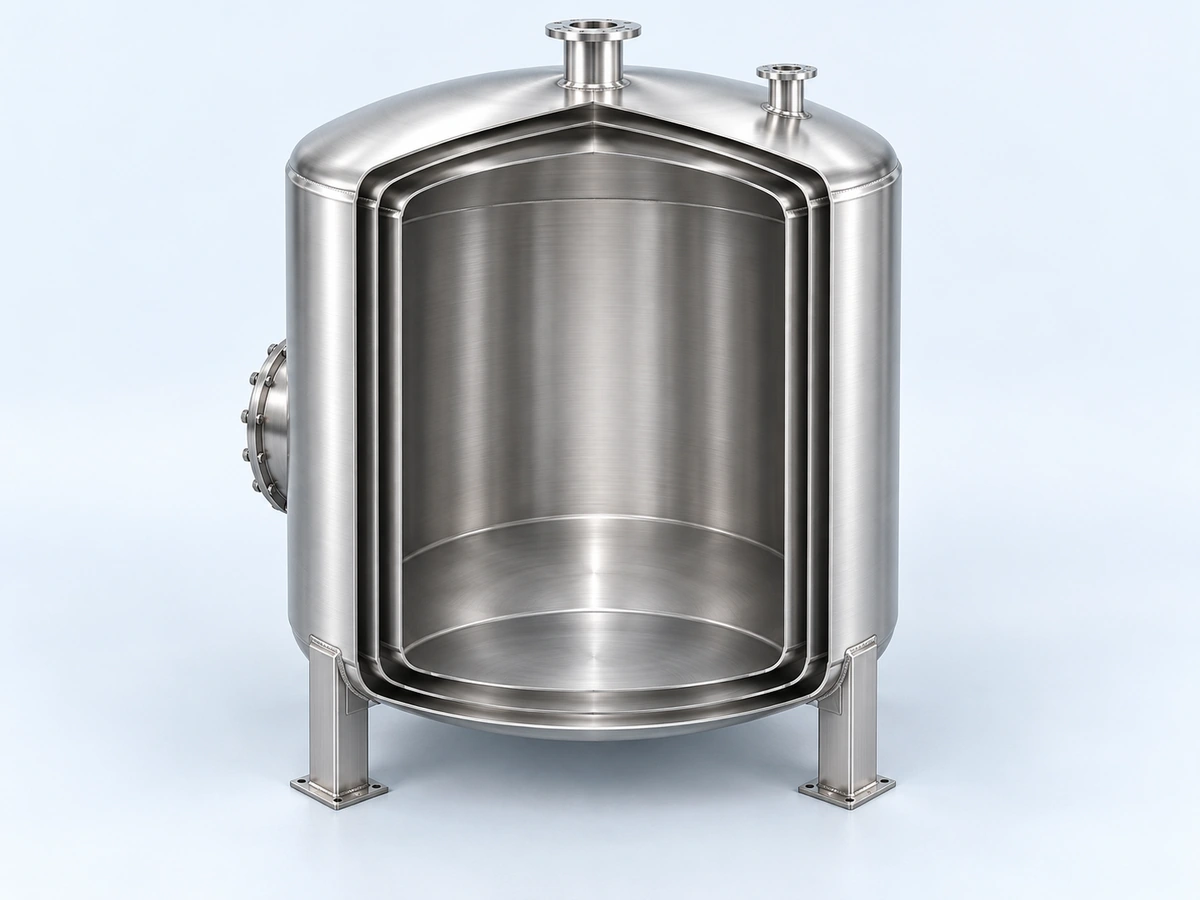
A triple-wall tank, with three concentric shells and two independent interstitial spaces, provides tertiary containment for toxic and corrosive materials and reduces the risk of a leak to the environment from order P² to P³.
Triple-wall steel tank
A technical reference on design, metallurgy, leak detection and standards
Storing hazardous chemicals — concentrated mineral acids, strong alkalis, volatile solvents, oxidisers and toxic compounds — sits at the crossroads of mechanics, metallurgy, corrosion chemistry and process safety. In these applications, containment is the main design requirement, not an added feature.
Primary containment is the wall holding the fluid; secondary containment is the barrier against primary failure (double-wall); tertiary containment is a third independent barrier against simultaneous or progressive failure of two layers — the basis of the triple-wall tank.
1. The risk logic of three-layer containment
If the independent failure probability of each wall is P, failure of two walls is of order P² and of three walls of order P³. With P = 0.001, a leak to the environment is about 10⁻⁶ for a double wall and about 10⁻⁹ for a triple wall — three orders of magnitude less risk where the consequence is catastrophic.
2. Structural architecture of a triple wall
Inner shell in contact with the fluid. IS-1 between the primary and middle shells. Intermediate shell as the second barrier. IS-2 between the middle and outer shells. Outer shell as the third barrier, carrying external loads, impact and the environment.
Uniform spacing with spot-welded or mesh standoffs; a load path to the base, free passage of the monitoring fluid/gas with no dead pockets, and minimal stress concentration. A blocked space will not carry the leak signal to the sensor.
3. Material selection and corrosion
| Grade | Key composition | Typical use |
|---|---|---|
| 304 / 304L | Cr-Ni · L is low-carbon | Mildly corrosive · avoids sensitization |
| 316 / 316L | Mo about 2–3% | Pitting and chlorides |
| 317L | Higher Mo | More severe chlorides |
| Duplex 2205 | Austenite-ferrite | Strength + chloride SCC |
| Super-duplex / Ni alloys | — | Severe acids, high temperature and chlorides |
CA = corrosion rate × design life; leak monitoring does not replace conservative design. L grades, heat-input control for duplex, passivation after welding, and NDT (RT/UT/PT) to code.
4. Basics of mechanical design
Thickness under internal pressure (ASME VIII Div. 1) and corrosion allowance; a vacuum in the interstitial space changes the criterion to buckling (UG-28):
With a permanent vacuum in the interstitial space, the adjacent wall is under external pressure and the design is governed by buckling to UG-28 with factors A and B; L/D₀ and D₀/t are decisive and stiffening rings are often needed. Ordered thickness = t + CA. Nozzle analysis by WRC 107/537 or FEA.
5. Interstitial leak detection system
The gold standard: a vacuum gauge/switch monitors the interstitial space. A leak in either the primary or the outer wall causes a loss of vacuum and an alarm; one sensor watches both adjacent walls, and the pressure difference stops material escaping to the environment.
Positive pressure with N₂ (pressure drop = leak; suits vacuum-sensitive materials). Low-point liquid sensors (conductivity/optical). Dedicated chemical monitoring (hydrocarbons, H₂S, acid vapour).
IS-1 and IS-2 are independent: an alarm only in IS-1 = primary failure; only in IS-2 = outer failure. An alarm moving IS-1→IS-2 = the middle wall is threatened. Preventive repair is possible while one sound barrier remains.
Display of both zones, audible and visual alarms, event logging, 4-20 mA / Modbus / Profibus output to DCS/SCADA and, if required, ESD activation.
6. Comparison: double-wall vs. triple-wall
| Criterion | Double-wall | Triple-wall |
|---|---|---|
| Containment levels | 1 (secondary) | 2 (secondary + tertiary) |
| Monitored spaces | 1 | 2 |
| Risk reduction | Order P² | Order P³ |
| Identifies leak source | No | Yes |
| Relative initial cost | 100% | ≈ 130–160% |
| Weight / outer diameter | Lower | Higher |
| Best use | Low/medium hazard, petroleum | Toxic, corrosive, environmentally sensitive |
A triple wall is justified when the consequence of a leak justifies 30–60% extra cost: acute toxicity, irreversible groundwater contamination, a legal requirement for tertiary containment, proximity to water sources or housing, or heavy insurance risk.
7. Design and inspection standards
ASME VIII Div. 1/2 for pressure and vacuum. API 650/620 for metal storage. API 653 for in-service inspection. EN 12285 / EN 14015 for secondary containment. UL 58 / UL 142 for multi-wall tanks and LDS. EN 13160 for leak detection systems. National environmental regulations for hazardous materials. The governing code should be fixed in the concept phase.
8. Inspection, testing and commissioning
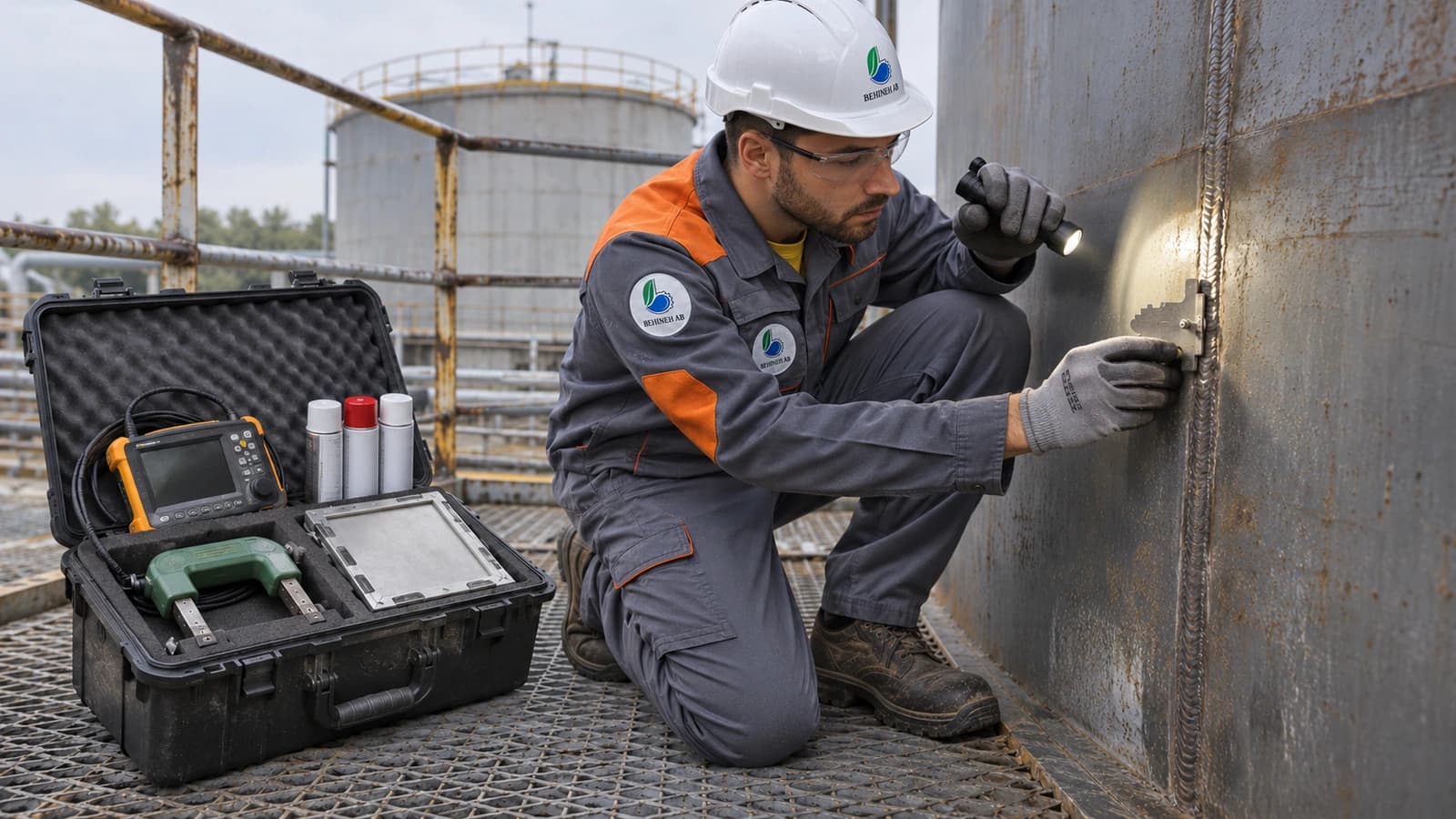
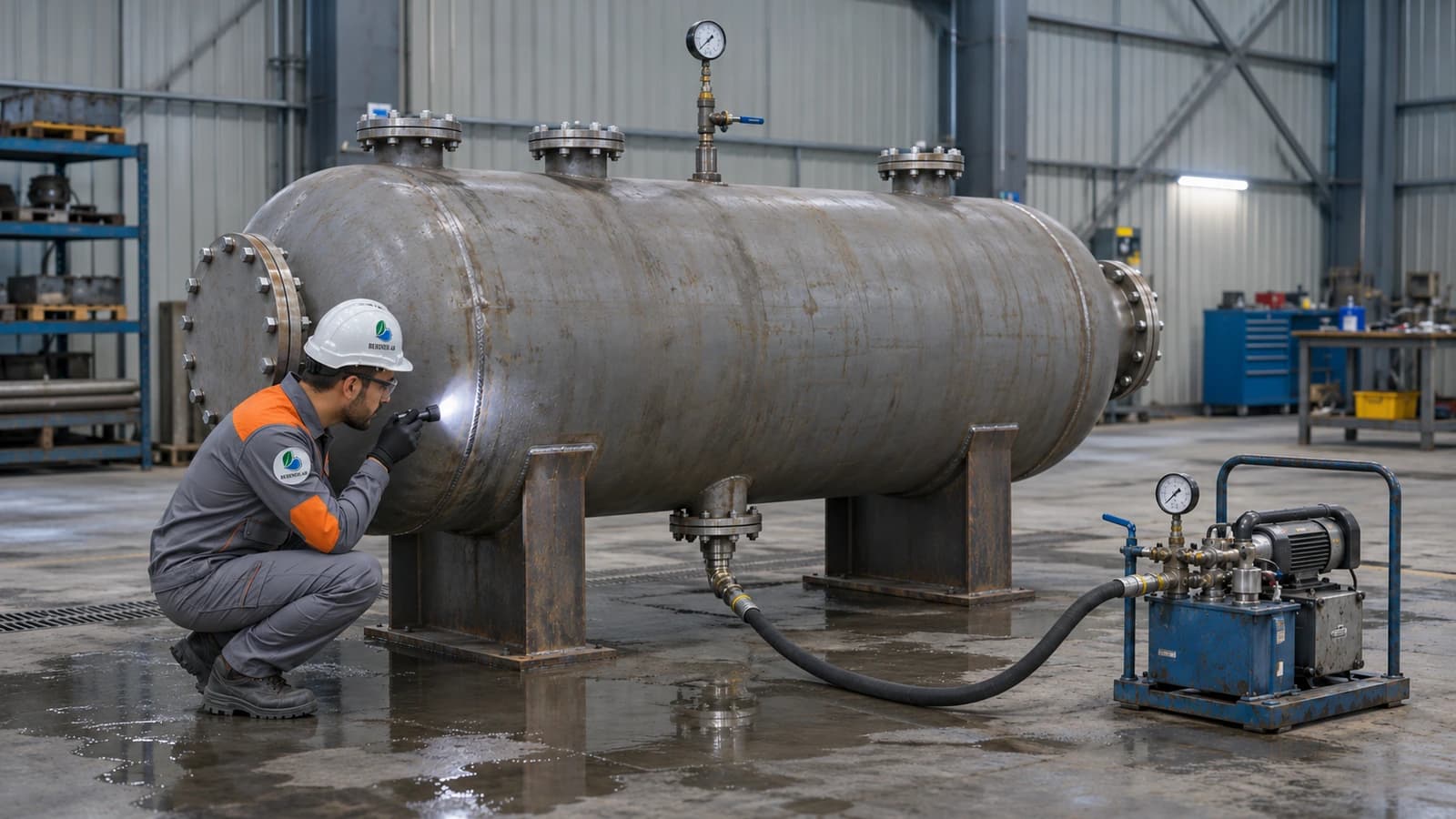
Independent tightness test of each interstitial space (vacuum/pressure). Hydrostatic test of the primary wall to the code factor. NDT: RT/UT of main seams, PT/MT of nozzles. LDS verification through to the DCS by simulating a leak. Periodic RBI inspection to API 653 and continuous vacuum/pressure monitoring.
9. Engineering summary
The triple-wall steel tank embodies defence in depth in containment engineering: three independent barriers, two monitored zones and vacuum logic bring the risk of a leak to the environment down by several orders of magnitude and show both the source and the progress of a failure.
This level of protection should come from QRA, the nature of the material and legal requirements, not be chosen by default. Behineh Ab Engineering supports your project from risk assessment through detailed design, fabrication and commissioning.
Technical specifications
When triple-wall instead of double-wall?
When the consequence of a leak to the environment (acute toxicity, groundwater contamination, a legal requirement or insurance risk) justifies the extra cost of about 30 to 60%. The choice should be based on QRA, not on default.
The advantage of dual-zone leak monitoring
An alarm only in IS-1 means the primary wall has failed; only in IS-2, the outer wall. An alarm moving from IS-1 to IS-2 means the middle wall is threatened and immediate action is needed.
Applications and industries
Photo gallery
Triple-wall tank gallery
Frequently asked questions
Request a quote
Triple-wall steel tank
Enter the pressure, temperature and fluid; our engineers send a technical proposal and price within 24 working hours.
- Written technical reply with a proposed concept drawing
- Site visit in Tehran and surroundings
- 24-month warranty on fabrication and welding