The hydrotest is a tank's final exam before delivery, and we carry it out in our own factory. The test pressure, the work before filling, and the mistake that can ruin a tank while it is being drained.
What is a hydrotest and why water?
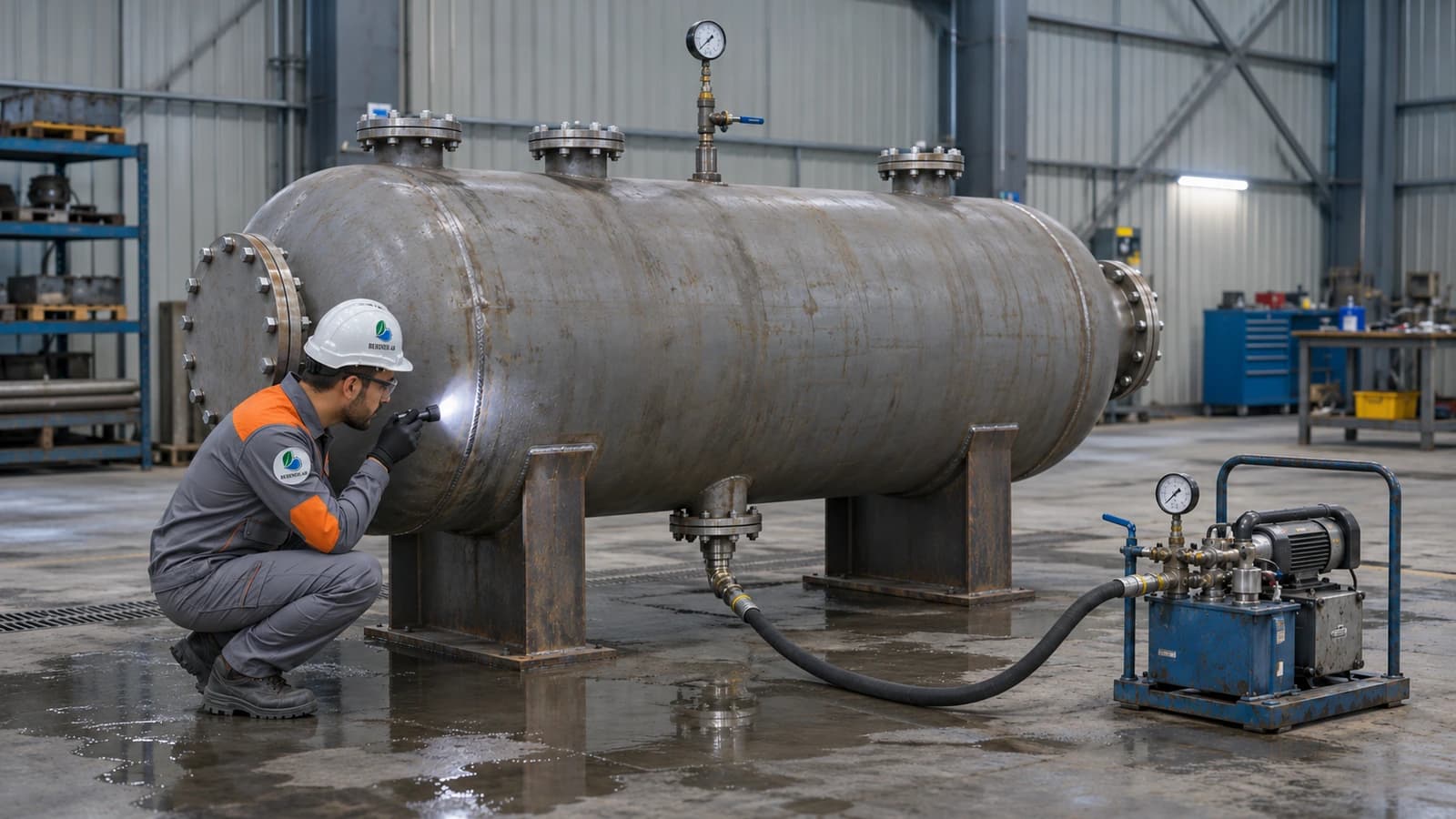
In a hydrostatic test the tank is filled with water and the pressure is raised above the design pressure. If a weld leaks or a plate is weak, it shows up here, not at the project site with the real fluid.
Water is chosen because it is almost incompressible. If the tank bursts during the test, the water has not stored much energy and simply pours out. Compressed air is not like that, which is why a pneumatic test is only allowed when water is genuinely not possible.
Before filling the tank
- All welding, including support and pad welds, must be finished. Welding after the test means testing again
- Non-destructive tests and, if required, post-weld heat treatment must have been done and accepted
- Install two calibrated pressure gauges with a range of about twice the test pressure
- Keep a vent open at the highest point so that the air inside the tank escapes completely
- Check the supports for the weight of the tank full of water, especially for horizontal tanks
- Water and metal temperature must be above the minimum allowable test temperature
Test stainless tanks with low-chloride water, and drain and dry the tank completely after the test. Water left in a stainless tank for a few weeks can be the start of pitting corrosion.
Test pressure by code
| Design code | Test pressure | Note |
|---|---|---|
| ASME Sec. VIII Div.1 | 1.3 times the maximum allowable working pressure | Multiplied by the ratio of allowable stress at test temperature to design temperature |
| API 650 (atmospheric tank) | Filling to the maximum design liquid level | The main aim is to check for leaks and foundation settlement |
| API 620 | Based on the design pressure and the relevant annex | Low-pressure tanks |
Steps of the test
The tank is filled from the bottom so that air escapes through the top vent. Then the pressure is raised gradually with the test pump, not all at once. When it reaches the test pressure, it is held for a while so that the connections and the gauge settle.
The welds are not inspected at full pressure. Under ASME, the pressure is lowered to the test value divided by 1.3, and then all welds and connections are examined up close. This way the inspector does not stand next to a tank at maximum pressure.
In large storage tanks built on site, filling is done in stages, and the foundation settlement is measured at each stage. If the settlement is uneven, filling is stopped.
The mistake that ruins a tank while draining
If the tank is drained with the vent closed, a vacuum forms inside. An atmospheric tank or a tank with thin plate is not designed for vacuum and may crumple like a can. A tank that must withstand vacuum, such as a vacuum tank, has a separate design for external pressure. This happens more often than you might think.
We carry out the hydrotest in our own factory. It is best done before the final paint, so that if a weld needs repair the work is easier. The test report must record the pressure, the holding time and the water temperature.