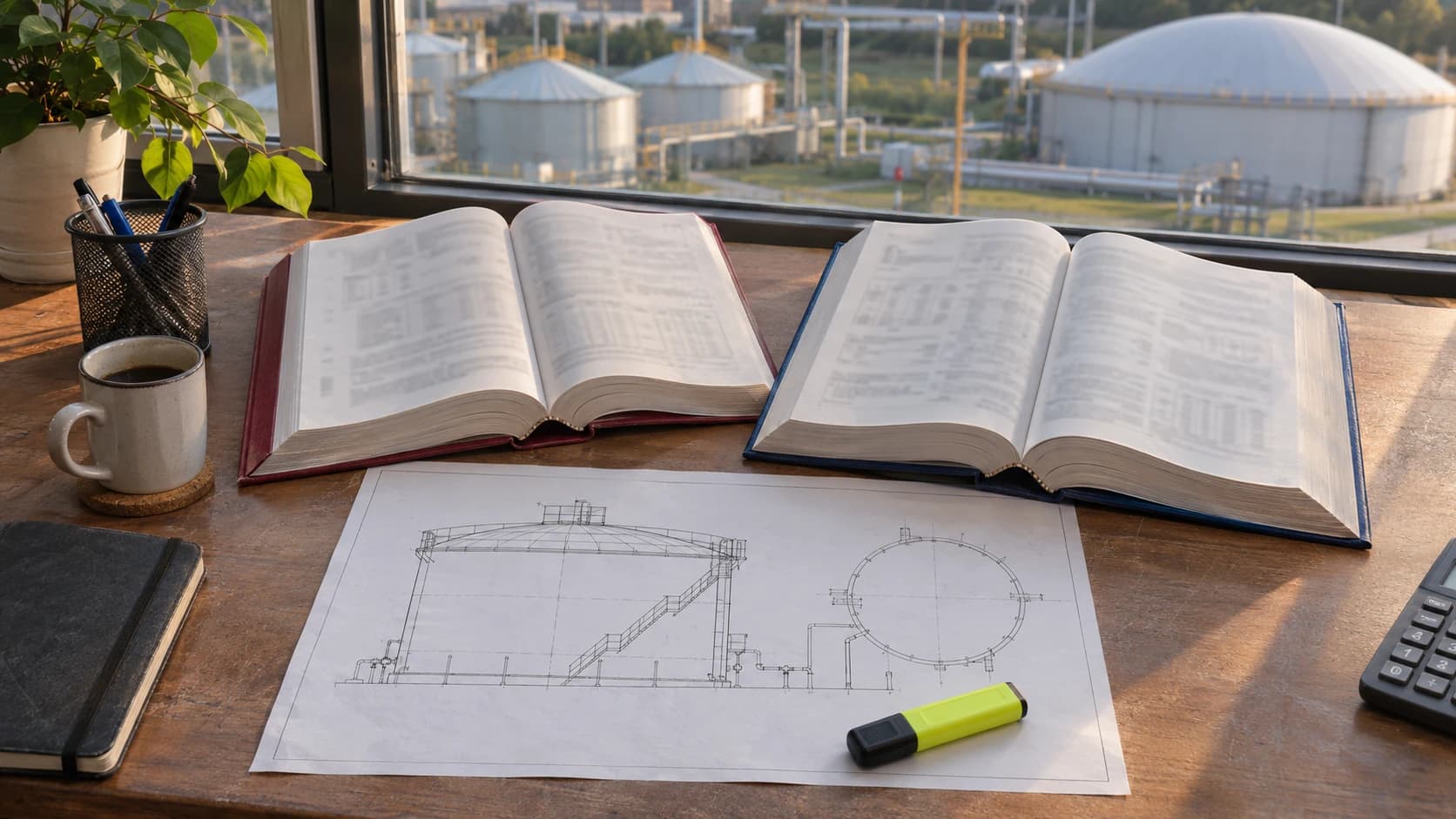
Shell, course, head, saddle, annular plate, MAWP, WPS and data book. Tank fabrication terms in plain language, as they are used in the workshop and on drawings.
Parts of a tank
| Term | Also called | What it means |
|---|---|---|
| Shell | Body, barrel | The cylindrical body of the tank |
| Course | Shell ring, strake | Each ring-shaped row of plate in the shell; the lower courses are thicker |
| Head | End, dished end | The top and bottom of a cylindrical tank; elliptical, torispherical, hemispherical or flat |
| Straight flange | SF | The short cylindrical part of the head that is welded to the shell |
| Nozzle | Connection, branch | Any inlet, outlet or instrument connection pipe on the shell |
| Manhole | Manway | A large opening for entering the inside of the tank |
| Reinforcing pad | Repad, compensation plate | The plate around a nozzle that makes up for the weakness caused by the hole |
| Annular plate | Annular ring | The ring of thick bottom plate under the shell in large tanks |
| Saddle | Saddle support | The support of a horizontal tank |
| Skirt | Skirt support | The cylindrical support of a tall vertical vessel |
| Vent | Breather | The breathing opening of an atmospheric tank |
The size of every hole in the shell is accounted for in the nozzle reinforcement calculations. We describe the head types and the thickness formula for each in the article on tank head formulas.
Design terms
| Term | What it means |
|---|---|
| Design pressure | The pressure the thicknesses are calculated for; a little higher than the working pressure |
| MAWP | Maximum allowable working pressure; the highest pressure the finished vessel can withstand |
| MDMT | Minimum design metal temperature; below this temperature there is a risk of brittle fracture |
| Corrosion allowance | Extra thickness allowed for metal loss to corrosion over the tank's life |
| Joint efficiency | A number between 0.7 and 1 that depends on the percentage of weld inspection and affects the thickness |
| Allowable stress | The highest stress the code permits for each plate grade at each temperature |
These numbers go directly into the thickness calculation. Corrosion allowance and joint efficiency each have their own article.
Welding, testing and documentation terms
| Term | What it means |
|---|---|
| WPS | Welding procedure specification; the process, electrode, current and preheat for each weld |
| PQR | The test report that proves the WPS is sound |
| WPQ | The welder's qualification certificate for a specific procedure |
| NDT | Non-destructive testing; RT, UT, PT, MT and vacuum box |
| Hydrotest | A test with water under a pressure above the design pressure |
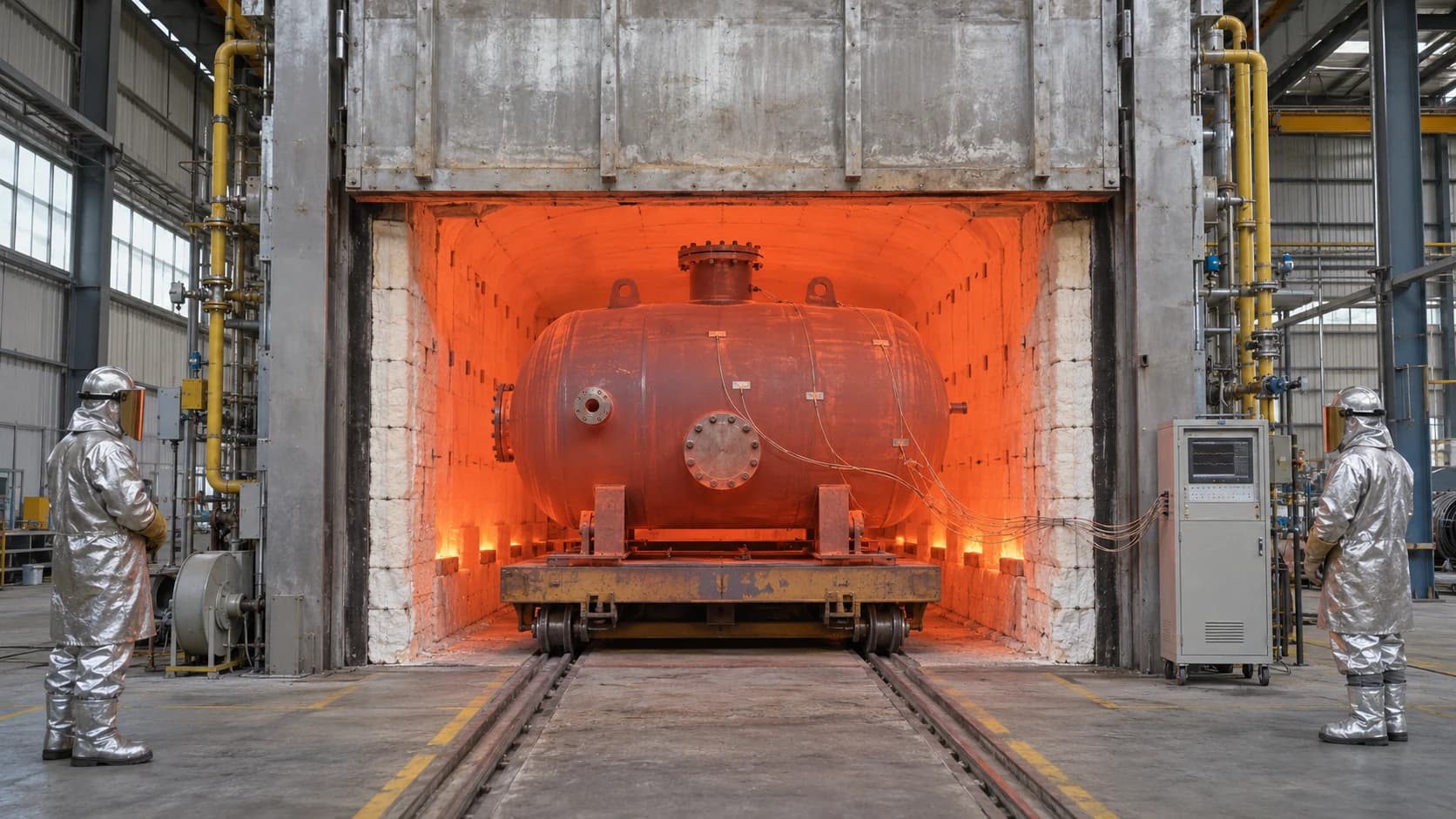
| PWHT | Post-weld heat treatment to relieve residual stress |
| MTC | The plate manufacturer's certificate with the chemical composition and mechanical properties |
| Nameplate | The data plate on the tank: manufacturer, year, design pressure and temperature |
| Data book | The fabrication document file: drawings, calculations, certificates and test reports |
We explain each test in detail in the articles on non-destructive tests and the hydrostatic test.
Terms for large storage tanks
| Term | What it means |
|---|---|
| Ringwall | The concrete foundation ring under the shell |
| Floating roof | A roof that floats on the liquid surface and eliminates the vapour space |
| Rim seal | The seal between the edge of the floating roof and the shell |
| Bund wall | The wall around a tank that contains a leak |
| Settlement | The foundation sinking under the weight of the full tank; measured during the hydrotest |
If a term on a drawing or quotation is not clear to you, ask before signing. Most disputes after fabrication start with one word that the two sides understood in two different ways.