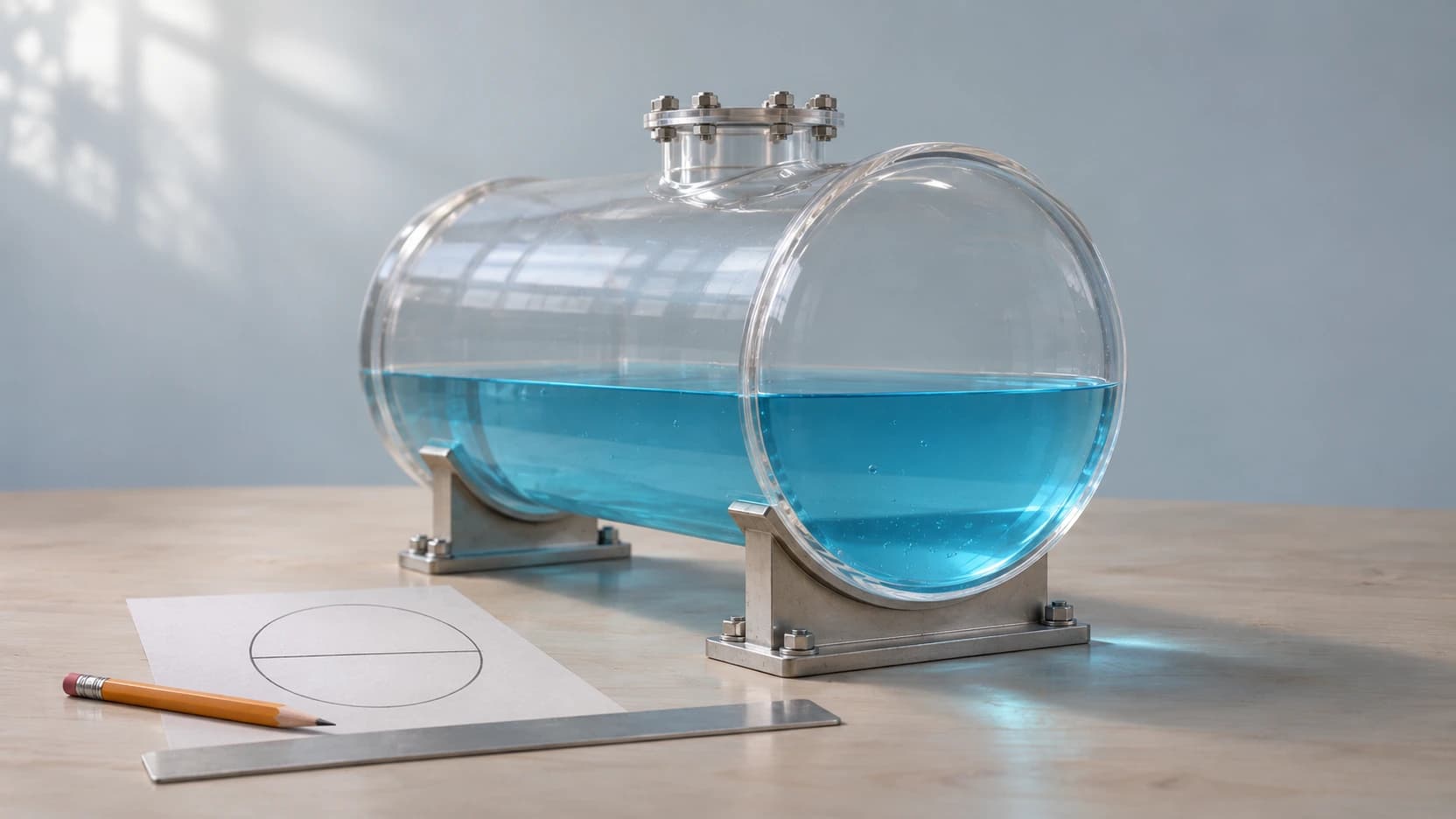
How many litres are left in a horizontal tank? The formula for the shell and head volume at a given liquid height, with a worked example and a fill-percentage table.
Why isn't it simple?
In a vertical tank, volume is linear with liquid height: half the height means half the volume. In a horizontal tank it is not. A height of 25 percent of the diameter fills only about 20 percent of the volume, and a height of 75 percent about 80 percent. That is why a dipstick in a horizontal tank does not give the right figure without a conversion table. We give the formula for the full volume of a full tank in the article on tank volume calculation; here we only look at the partly filled case.
Shell volume at height h
The liquid cross-section in the shell is a circular segment. Its area, with radius r and liquid height h, is: A = r² × arccos((r − h) / r) − (r − h) × √(2rh − h²). The arccos angle must be in radians. The liquid volume in the shell equals A times the shell length.
Liquid volume in the heads
Two elliptical or hemispherical heads put together form a complete ellipsoid. The liquid volume in both heads at height h is: V = π × a × h² × (3r − h) / (3r). In this formula a is the depth of each head: D/4 for a 2:1 elliptical head and r for a hemisphere. At h = 2r, this formula gives exactly the full volume of the two heads.
For a torispherical head there is no simple closed formula. Using the elliptical formula with the head's actual depth gives an acceptable approximation. Because the heads usually make up a small share of the total volume, the error in the final figure is negligible.
Worked example
- r = 1 m and r − h = 0.5 m
- arccos(0.5) = 1.0472 rad and √(2rh − h²) = √0.75 = 0.866
- Cross-section area: 1.0472 − 0.5 × 0.866 = 0.614 m²
- Shell volume: 0.614 × 5 = 3.07 m³
- Head volume with a = 0.5: π × 0.5 × 0.25 × 2.5 / 3 = 0.33 m³
- Total: about 3.4 m³, i.e. 3,400 litres of the 17,800-litre total volume (about 19 percent)
Quick table: height percentage to shell volume percentage
| Liquid height (% of diameter) | Shell volume (% of total) |
|---|---|
| 10% | About 5.2% |
| 20% | About 14.2% |
| 25% | About 19.6% |
| 30% | About 25.2% |
| 40% | About 37.4% |
| 50% | 50% |
| 60% | About 62.6% |
| 75% | About 80.4% |
| 90% | About 94.8% |
This table is for the shell only. The heads behave slightly differently, but in long tanks their share is small. For an exact calibration table for a specific tank, a full calculation is needed. The online tank calculator shows the tank's dimensions and volume.
In a horizontal tank, height and volume are not linear. The circular segment formula for the shell and the ellipsoid formula for the heads give the volume at any height with good accuracy.